Christian Collberg
Department of Computer Science
University of Arizona
Pattern Syntax:
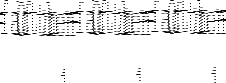
fact Revisited:
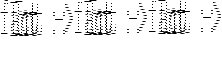


 is applied to an argument,
Haskell looks at each definition of until the
argument matches one of the patterns.
is applied to an argument,
Haskell looks at each definition of until the
argument matches one of the patterns.

| Pattern | Syntax | Example | Description |
| variable | var_name | fact n =  |
n matches any argument |
| constant | literal | fact 0 = |
matches the value |
| wildcard | _ | five _ = 5 | _ matches any argument |
| (n+k) pat. | (n+k) | fact (n+1) = |
(n+k) matches any integer  |
| Pattern | Syntax | Example | Description |
| cons | (x:xs) | len (x:xs) = |
matches non-empty list |
| empty | [ ] | len [ ] = 0 | matches the empty list |
| one-elem | [x] | len [x] = 1 | matches a list with exactly 1 element. |
| two-elem | [x,y] | len [x,y] = 2 | matches a list with exactly 2 elements. |
Using conditional expr:
![\begin{gprogram}
sumlist :: [Int] -> Int \\
sumlist xs = \= if xs == [\ ] then 0 \\
\x else head xs + sumlist(tail xs)
\end{gprogram}](img11.gif)
Using patterns:
![\begin{gprogram}
sumlist :: [Int] -> Int \\
sumlist [\ ] = 0 \\
sumlist (x:xs) = x + sumlist xs
\end{gprogram}](img12.gif)
Using conditional expr:
![\begin{gprogram}
len :: [Int] -> Int \\
len s = \xxx if s == [\ ] then 0 else 1 + len (tail s)
\end{gprogram}](img13.gif)
Using patterns:
![\begin{gprogram}
len :: [Int] -> Int \\
len [\ ] = 0 \\
len (\_:xs) = 1 + len xs
\end{gprogram}](img14.gif)
Using conditional expr:

Using patterns:


 ).
).
![\begin{gprogram}
member :: Int -> [Int] -> Bool \\
member x L = $\cdots$\ \\
\...
...[1,2,3]} \\
\x True \\
\redtxt{? member 4 [1,2,3]} \\
\x False
\end{gprogram}](img20.gif)
![\begin{gprogram}
memberNum :: Int -> [Int] -> Int \\
unique :: [Int] -> Int \\ ...
...[1,5,2,3,5,5]} \\
\x 3\\
\redtxt{? unique [2,4,2,1,4]} \\
\x 1
\end{gprogram}](img21.gif)