
 is a phrase in the language, we define a mapping
 such that

is a mathematical entity that models the semantics of
.
Christian Collberg
Department of Computer Science
University of Arizona
is a phrase in the language, we define a mapping
such that
.
 ,
,  ,
,  ,
,  all
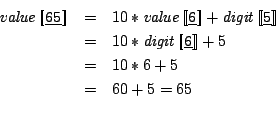
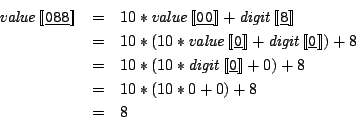
denote the same abstract object, 8:
all
denote the same abstract object, 8:

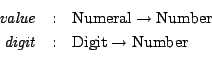
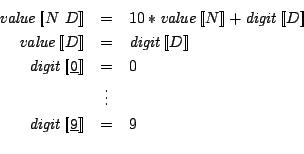
 : Numeral
 : Digit
![\begin{EBNF}
\item[{Numeral}] \!Digit! \vert \!Numeral! \!Digit!
\item[{Digit}...
...3: \vert \:4: \vert \:5: \vert \:6: \vert \:7: \vert \:8: \vert \:9:
\end{EBNF}](img13.gif)
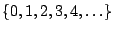

These are the abstract syntactic domains of Wren:
 :
:
 :
: :
:
 :
:
 :
:
 :
: :
:
 :
:
![\begin{EBNF}
\item[Program] \:program: \!identifier! \:is: \!Declaration!* \:be...
...\vert \:+: \vert
\:: \vert \:*: \vert \:/: \vert \:and: \vert \:or:
\end{EBNF}](img34.gif)
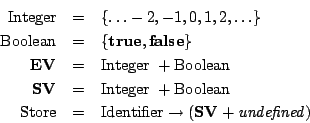
 (storable values) represents the values that may be
placed in the store.
(storable values) represents the values that may be
placed in the store.
 (expressible or first-class values) represents the values
that expressions can produce.
(expressible or first-class values) represents the values
that expressions can produce.






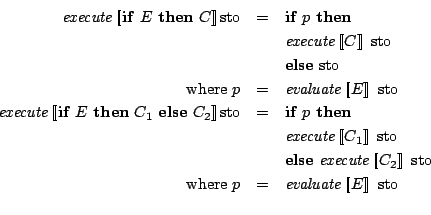
 does not affect the store:


type Num =  Rational

data SV    = IVal Num | BVal Bool | Undefined

type Identifier = String

data Operator  = Add | Sub | Mul | Minus | Div | Not |
                 Or | And | Lt | Gt | Eq | Ne | Le | Ge

data Expression = Id String |
                  LitInt Num |
                  TrueVal |
                  FalseVal |
                  Unary Operator Expression |
                  Binary Expression Operator Expression
data Program = Prog [Declaration] Command

data Declaration = Var [Identifier] Type

data Type = IntType | BoolType

data Command = Skip |
               Assign String Expression |
               Read String |
               Write Expression |
               IfThen Expression Command |
               IfThenElse Expression Command Command |
               While Expression Command |
               Seq Command Command
bcompute :: SV -> Operator -> SV -> SV
bcompute (IVal a) Add (IVal b) = (IVal (a + b))
bcompute (IVal a) Mul (IVal b) = (IVal (a * b))
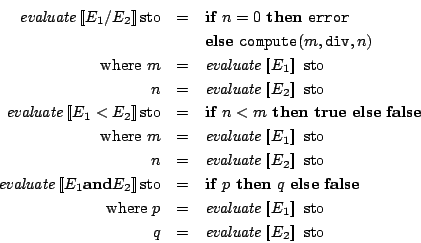
bcompute (IVal a) Div (IVal b) =
      if b==0 then error "Division by 0"
      else         (IVal (toRational(a / b)))
bcompute (IVal a) Sub (IVal b) = (IVal (a - b))
bcompute (BVal a) And (BVal b) = (BVal (a && b))
bcompute (BVal a) Or  (BVal b) = (BVal (a || b))
bcompute (IVal a) Lt  (IVal b) = (BVal (a < b))
bcompute (IVal a) Gt  (IVal b) = (BVal (a > b))
bcompute (IVal a) Le  (IVal b) = (BVal (a <= b))
bcompute (IVal a) Ge  (IVal b) = (BVal (a >= b))
bcompute (IVal a) Eq  (IVal b) = (BVal (a == b))
bcompute (IVal a) Ne  (IVal b) = (BVal (not (a == b)))
ucompute :: Operator -> SV -> SV
ucompute Minus (IVal b) = (IVal (- b))
ucompute Not (BVal b) = (BVal (not b))
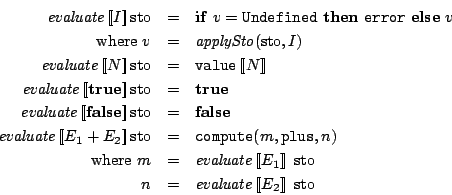
evaluate :: Expression -> Store -> SV
evaluate (Id id) sto =
      if val == Undefined then val else val
         where val = applySto sto id
evaluate (LitInt n) sto = (IVal n)
evaluate (TrueVal) sto = (BVal True)
evaluate (FalseVal) sto = (BVal False)
evaluate (Unary op r) sto = ucompute op n
   where n = evaluate r sto
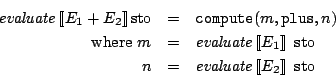
evaluate (Binary l op r) sto = bcompute m op n
   where m = evaluate l sto
         n = evaluate r sto
> s1
[("b",True),("a",5 % 1)]

> evaluate (Binary (LitInt 5) Add (LitInt 6)) s1
11 % 1

> evaluate (Binary (LitInt 5) Add (Id "a")) s1
10 % 1

> evaluate (Binary (Binary (LitInt 6) Mul (LitInt 2)) Add (Id "a")) s1
17 % 1
execute :: Command -> Store -> Store
execute (Skip) sto = sto
execute (Assign id e) sto = updateSto sto id (evaluate e sto)
execute (Seq c1 c2) sto = execute c2 (execute c1 sto)
execute (IfThen b c) sto =
     if (evaluate b sto) == (BVal True) then
         execute c sto
     else sto
execute (IfThenElse b c1 c2) sto =
     if (evaluate b sto) == (BVal True) then
         execute c1 sto
      else execute c2 sto
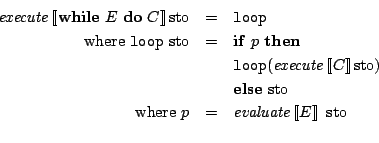
execute (While b c) sto = loop sto
   where loop sto = if (evaluate b sto) == (BVal True) then
                    (loop (execute c sto)) else sto
> s1
[("b",True),("a",5 % 1)]

> execute (Assign "a" (LitInt 9)) s1
[("a",9 % 1),("b",True)]

> execute (IfThen (Unary Not (Id "b")) (Assign "a" (LitInt 9))) s1
[("b",True),("a",5 % 1)]

> execute (While (Binary (Id "a") Lt (LitInt 10)) (Assign "a" (Binary (Id "a") Add (LitInt 1)))) s1
[("a",10 % 1),("b",True)]
type Store = [(Identifier,SV)]

emptySto:: Store
emptySto = []

updateSto::  Store -> Identifier -> SV -> Store
updateSto env id val =
   (id,val) : (filter (\ (x,_) -> not(id==x)) env)

applySto::  Store -> Identifier -> SV
applySto env id =
   snd (foldl (\ r c -> if id==(fst r) then r else c) ("",Undefined) env)
s1 = updateSto (updateSto emptySto "a" (IVal 5)) "b" (BVal True)

> s1
[("b",True),("a",5 % 1)]

> applySto s1 "a"
5 % 1

> applySto s1 "b"
True

> applySto emptySto "a"
Undefined