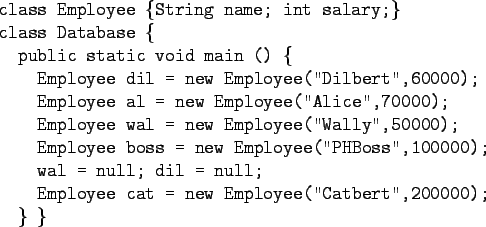
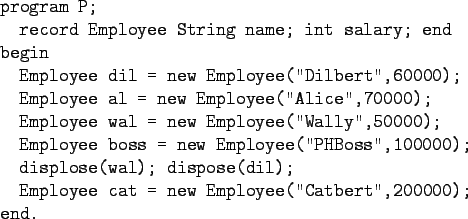
We need a fully dynamic memory allocation strategy. Employees can
quit or be fired in any order relative to their hiring.
The data structure used to provide general memory allocation such as
this is called a heap. It's not the same type of heap you learned about
(or will learn about) in a data structures course (those heaps were used
to implement a priority queue). Our heap is simply a data structure for
keeping track of memory.
The heap grows upward from the top of the text. Initially the heap
contains the static data from the program, and one big free region to
hold dynamic data. Once this space is used up, the operating system
is invoked to increase the size of the heap by moving the boundary
up towards the stack.
Each program has its own heap and stack.
When the stack and heap collide your program runs out of memory.
The heap starts with one big free region, but after the program has been
running for a while it will probably be divided into some regions that
are being used by the program, and some that are not (employees have
been hired and fired). In the following, shaded regions of memory are
in-use (they contain data that are being used by the program). Blank
regions are not in-use (free).
When the OS increases the size of the heap, more free memory is added
to the right of this picture.
When the program wants memory from the heap, we must allocate
some from one of the free regions. For each free region we need to
know its starting address and its size.
Where should this information be kept? In an array? This has the same
problems as allocating the employee structures themselves in an array.
A linked-list called the free list is a better choice. Since the regions we
are linking are free space, we can put the linked-list structures in the
free regions.
Think of each free region as a structure. Different regions are
different sizes, so the structures have different sizes, but all begin
with a standard header. The header contains the links for making
the linked-list of free regions, and the size of the region.
The previous picture of memory looks like the following with the
free-list added.
If what is left is too small to hold a header malloc simply returns
the entire region. The program that called malloc will get more
memory then it asked for, but that doesn't matter.
malloc should return a word-aligned region that can store integers.
The easiest way to do this is to start with the heap word-aligned,
and always allocate memory in multiples of the word size.
What happens if the program asks for 50 bytes, but then writes 60
bytes to the region? The last 10 bytes overwrite the first 10 bytes of
the next region. This will corrupt the free list if the next region is
free (and probably crash the program if it is not).
For this reason it's a good idea to have a magic number in the free
list node headers. This is a distinctive value that malloc checks
when traversing the free list, and complains if the value changes
(which indicates the list is corrupted). For example, put a field in
the header whose value is always 0xfeedface.
There may be many regions big enough to satisfy a request. Which one
should be used? First, why does it make a difference? Consider a heap
that has two free regions, separated by allocated memory. Each region
contains 50 bytes. malloc can't satisfy a request for 100 bytes, even
though there is enough total free memory.
This is called memory compaction, and doesn't work in general
because it changes the address of memory previously returned
by malloc. Most programs cannot handle this.
Memory fragmentation is what occurs when the free space is in
regions too small to be useful. We want our allocation scheme to
avoid fragmentation, if possible.
Note that there is no fragmentation with stack allocation because
the free space is always in one big piece.
Without compaction it is impossible to avoid fragmentation
entirely.
malloc returns the biggest region that satisfies the request.
This avoids the "lots of tiny regions" problem. The idea is that the amount
"left over" is likely to be big enough to satisfy a subsequent request.
This tends to produce free regions of about the same size.
Best-fit will allocate from the 15-byte region, leaving a region of 3
byte. Probably will return all 15 bytes as the 3-byte region is too
small to hold a node structure.
To avoid searching the entire list First-fit allocates space from
the first region on the free list that is big enough. It has the
side-effect of leaving lots of small regions at
the front of the list, while the larger are at the end.
Next-fit works like First-fit except that it starts
searching at the region following the last region allocated. It tends to
leave average-sized regions.
is used to release memory
when it is no longer needed (e.g. an employee quits or is fired).
The address parameter is a pointer to the region to be freed, and it must
have previously been returned by malloc.
In C the type "void *" means a pointer to an unspecified type
(it can be a pointer to anything, much like a reference to an object of
type "Object" in Java).
free inserts the region into the free list. It must fill in the header to do
so, but this introduces a problem. How does free determine the size
of the region? It is only given its address, not its size. One solution is
to store the size elsewhere, such as in an array.
A simple solution is to put a hidden header on allocated regions. This
header contains the size of the region, and is stored in memory just
before the allocated region.
I call it "hidden" because it is not seen by
the program that called malloc; malloc returns the address of the
first byte after the hidden header.
There is a significant problem with this simple implementation of
free. Consider the following memory status:
heap5
An employee quits, making an allocated region free:
heap6
Note that there are now three consecutive free regions (A,B,C),
without any allocated regions between them. They should be
coalesced into one large free region:
Free needs to find the two regions on either side (A,C) of the region
being freed (B), and if either is also free, merge it with the current
region into a single region.
How does free find adjacent regions? One option is to keep the free
list sorted by address. When a region is freed insert it into the
correct place in the list, then check to see if the free regions before
and after it on the list are adjacent.
There are many different memory allocation algorithms.
Many optimize the amount of space used for the header.
Binning:
keeps separate lists for regions of the same size. Good if the
program allocates and frees lots of regions of the same size (e.g.
employee structures).
if regions are of the same size (blocks), keep a bit map
instead of a free list. One bit per block: 1 means allocated, 0 means
free. One word of the bit map represents 32 blocks. Index of bit in
bit map is the index of the region in the "array" of regions.
Garbage collection:
if a program does not have a pointer to a particular
region of memory, that memory cannot be accessed by the program
and can be automatically added to the free list. The programmer
allocates memory, but never calls free. Examples: Lisp, Java